Back
Back 
TL;DR
- WebMCP is a new browser API that allows websites to declare their functions in a structured and machine-readable way, so that AI agents can discover and use them directly like APIs.
- The goal is to create a standard protocol for the collaboration of web and AI directly in the browser.
- This brings efficiency, new opportunities for SEO & Structured Data and agent-based web apps, but presents challenges in terms of adoption by webmasters, liability and security.
What is MCP?
If you have already worked with the Model Context Protocol (MCP), which Anthropic introduced in November 2024 and later handed over to the Linux Foundation, WebMCP will feel very familiar.
MCP and WebMCP aim to create a standardized interface through which AI models (AI agents) can reliably interact with external tools and contexts. WebMCP now brings this concept directly to the browser, opening up new possibilities for agent-based web applications.
In the near future, Web MCP will be a communication protocol between websites and AI agents.
Is WebMCP the future website API?
Smaller companies can integrate these new adjustments into their websites much more easily, while large market players have to expend considerable effort to incorporate the updates into existing systems (websites).
WebMCP provides structured tools that must be declared in JavaScript or HTML. These tools can be discovered and called by AI agents like an API. In combination with Google Chrome, WebMCP is the latest approach to date and structurally very innovative.
The new communication channel allows AI agents to interact directly via the WebMCP tool protocol without having to create accessibility snapshots or perform pixel-based analyses. This could increase the importance of technical SEO and structured data.
In the future, Google will likely move away from building agents that laboriously navigate existing websites and instead focus on modifying the websites themselves. Pages would need to explicitly declare their capabilities, allowing agents to bypass navigation entirely. They could interact directly with the available features, find information much faster and save significant resources.
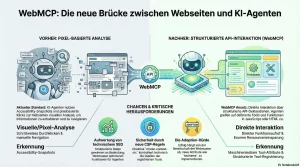
WebMCP and challenges
Until now, browser agents have used AccessibilitySnapshot-based representations of the page to view and compare content and interactive elements. WebMCP would replace this workaround by providing direct API-like interfaces in the browser.
Instead of making AI agents increasingly intelligent, WebMCP takes the approach of making websites more machine-readable. Users will see a WebMCP-annotated website completely unchanged, as this additional information is invisible unless specifically searched for.
No one is forcing website operators to add toolname attributes to their forms, and therein lies the biggest challenge. The crucial factor will be how readily webmasters adapt. Will they recognize WebMCP as a genuine added value and integrate it accordingly into their websites?
WebMCP and Security
The truly difficult security issues, however, concern less the API itself and more the behavior of the AI agents that use it. For example, if an online shop offers a purchase_item tool and an agent calls it on behalf of the user, the question of liability arises in the event of incorrect purchases.
These problems are not specific to WebMCP, but rather fundamental issues of trust in dealing with AI agents. However, WebMCP makes such risks more transparent, which is definitely an advantage. Structured tool calls are significantly easier to review and audit than complex sequences of pixel-based clicks.