Back
Back 
TL;DR
- AI search evaluates content based on context, structure and user intent, traditional SEO metrics alone fall short.
- Log file analysis is the most important tool for understanding the crawling behavior of AI bots and for identifying technical problems early on.
- Content strategy includes: scaling plus E-E-A-T plus human-in-the-loop. Only content with genuine expertise ranks sustainably in AI answers.
- The 5 core metrics for GEO/AEO: Brand Mentions, AI Search Market Share, AI Referral Traffic, Conversions and Brand Sentiment.
Challenges of AI search visibility
AI-powered search rewards content that is contextual, well-structured, and aligned with user intent. Maintaining this quality consistently across hundreds or thousands of assets poses significant challenges for marketing teams and SEO tools.
Scaling without compromising accuracy, originality, or brand identity is becoming increasingly difficult, especially with AI-generated content at scale.
AI search engines often deliver results without a traditional click, making it difficult to measure success using standard analytics. Attribution becomes unclear when visibility, influence and brand awareness are more important than pure traffic.
SEO/GEO managers struggle to directly link presence in AI-powered search functions with revenue or conversions.
Unlike traditional search engines, many AI crawlers lack transparency regarding the content they retrieve, index, or reuse. This makes it difficult to determine which content influences AI-generated results, or whether it is even considered at all.
Log file analysis for AI bots
Log file analysis is particularly important for AI traffic because it is often the most reliable source for understanding how LLMs and AI bots actually interact with a website. Server logs clearly show which AI bots (e.g., from OpenAI, Anthropic, Google, Perplexity) crawl which content, when, how often, and what content they crawl.
What are the benefits of log file analysis?
- Early detection of crawling problems: Immediately visible whether important pages are not reached by AI bots, whether crawl budget is being wasted, or whether technical hurdles such as status codes, loading times, or robots rules are blocking access.
- Prioritization & Optimization: The logs show which content is used most frequently by AI systems, thus providing the basis for targeted optimization.
- Strategy, control & protection: A sound basis for strategic decisions regarding AI crawling behavior and content protection.
No-Content-Slop!
How can relevant content be created without producing a so-called “content slop”? The answer lies in the E-E-A-T principles: personal experience and expertise are indispensable. Fast AI-generated content can serve as inspiration, but should never be copied verbatim. The Expertise and a human element in the loop are crucial for high-quality content.
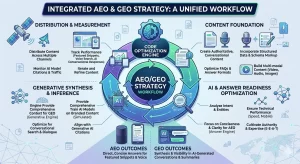
3 AEO/GEO Content Strategies
- Scalable topic coverage with editorial control – The use of AI enables brands to cover entire subject areas efficiently and consistently. Combined with rigorous editorial standards, this approach helps build thematic expertise by answering a wide range of relevant user questions. The key lies in the combination of scalability, depth and human input.
- Structured Data & Schema Markup – Structured data helps search engines and AI systems clearly understand the meaning, context, and relationships of content. Schema markup increases the likelihood that content will appear in rich results and AI-generated answers.
- Long-format guides as an AI reference source – The detailed, long-format guides signal expertise and credibility to both users and AI systems. They offer a comprehensive overview of complex topics and are ideally suited as a basis for AI responses.
AEO/GEO Technology Features
- AEO/GEO visibility (brand mention & domain citation tracking) – It is important to understand where and how a brand or domain is mentioned or cited in AI-generated results. AI search extends the visibility measurement of rankings to actual presence in search engines. This is fundamental to understanding brand influence in AI-powered search systems.
- Comprehensive coverage of all AI search engines – The visibility of AI varies significantly across different search engines, as each uses different data sources. Comprehensive coverage allows brands to monitor performance consistently across platforms, rather than in isolated systems. This enables a more accurate overview of the overall market share in AI search engines.
- Content optimization based on AI search capabilities – AI tools translate AI result patterns into actionable content-, structure-, or entity-based recommendations. The goal is to prioritize measures that directly increase the integration of AI responses.
- Competitive comparison of AI results – The comparison helps identify which competitors dominate AI-generated answers on key topics. Market share analyses help GEO managers identify strategic concepts and untapped market potential. This shifts the competitive focus from search results to brand dominance in AI-generated responses.
- AI referral traffic – This feature captures traffic originating directly from AI platforms when citations or links are provided. While the search volume may be lower than with traditional search, the search intent is often more qualified, e.g., leading to more conversions.
5 important AEO/GEO metrics
- Brand Mentions → This metric captures the frequency with which your brand name appears in AI responses.
- AI Search Market Share → This metric measures how often your brand is mentioned in AI-generated responses (e.g., ChatGPT, Copilot, Perplexity, Gemini) compared to competitors.
- AI Referral Traffic → This metric shows how many visitors are actually directed to your website via AI search tools.
- Conversions/Leads → The ultimate success indicator: How many users who come via AI searches actually become customers or qualified leads.
- Brand Sentiment → Hier wird bewertet, ob KI-Systeme deine Marke positiv, neutral oder negativ darstellen. Das ist entscheidend für das Vertrauen und die Marken-Reputation.