Back
Back 
TL;DR
- In AI search, sentiment determines whether your brand is perceived as trustworthy (positive), factual (neutral), or problematic (negative).
- Strategy: You should distinguish between branded prompts (reputation protection at the point of purchase) and non-branded prompts (reach during the orientation phase).
- Measurement: Your analysis is based on absolute, relative, and competitive sentiment.
- Optimization: Influence exerted by owned media (your website) and particularly credible earned media (external reviews/reports about your brand).
- If you don’t actively manage AI sentiment, you leave your brand reputation to the whims of algorithms.
Sentiment in AI systems describes how AI assistants like ChatGPT, Gemini, or Perplexity speak about your brand, your product, or a person (you): positively, neutrally, or negatively. In the context of Generative Engine Optimization (GEO), this sentiment becomes a critical success factor: today, users often read only the AI-generated answer rather than clicking through “ten blue links.” If you are misrepresented here, you lose trust before your website is even visited.
Sentiment: Fundamentals and Definition
The question “What is Generative Engine Optimization?” quickly leads you to the core: sentiment is the attitude an AI system expresses toward your brand, your product, or a person (regarding you). Unlike traditional sentiment analysis on social media, GEO examines two distinct levels:
- The first level is the prompt input: the very phrasing of the user’s question carries a certain sentiment (“best SEO/GEO providers” versus “problems with SEO/GEO providers”). The AI response represents a distinct layer, essentially how the model categorizes, weights and describes your brand.
- At the second level, tone is evaluated across three categories: positive, neutral, or negative. Beyond AI visibility, which simply tracks whether your brand is mentioned, the tone of the mention is also analyzed. A neutral mention appearing alongside a competitor receiving glowing praise is effectively a disadvantage for you. It is precisely this distinction that makes sentiment analysis an essential component of modern search optimization, setting it apart from mere keyword research.
Prompt Types: Branded Prompts & Non-Branded Prompts
In so-called “GEO optimization”, it is worthwhile to distinguish between two types of prompts, as they reflect different stages of the customer journey.
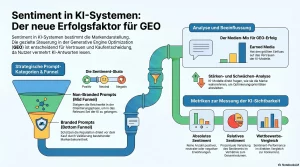
Branded prompts contain an explicit reference to a brand, for example, “How good is the Nobbseo brand?”. They sit at the bottom of the funnel, close to the point of purchase, the user is already familiar with your brand and is seeking confirmation. In this context, managing sentiment is a crucial part of optimization: a negative perception results in an immediate, significant loss of revenue for you.
Non-branded prompts are phrased in an open-ended way (e.g., “best solution for AI visibility”). They belong in the mid-funnel—the exploration phase where the model is just beginning to compile a selection of providers. Appearing here allows you to gain reach among users who have no prior brand bias.
You are essentially familiar with both categories from classic “ChatGPT SEO“, yet only their combination provides a complete picture. Branded prompts protect your reputation, while non-branded prompts tap into new demand. A sound strategy addresses both in parallel and regularly monitors the sentiment associated with your brand in each category.
Sentiment Strategies for GEO
Two concrete strategies emerge as the foundation for your professional AI search engine optimization:
- Your branded prompts should reflect only positive responses: you should safeguard existing praise and deliberately avoid or, where possible, mitigate negative content. If a negative prompt regarding your brand appears, do not ignore the feedback. Instead, use this signal to genuinely improve your service, as AI models often cite real-world sources. A frequently underestimated lever is the correction of technical SEO errors: only content that is clearly readable by the AI (e.g., clear HTML structure, valid schema markup) can be reproduced accurately.
- With non-branded prompts, the objective shifts: all positive prompts serve to build AI visibility & reach and that is precisely the selection you want to be included in. Conversely, with negative non-branded prompts (e.g., “worst providers”), the actual goal is for your service “not” to be mentioned.
This logic makes GEO optimization controllable: for each prompt type, you can define whether your brand should aim for visibility, tone enhancement, or intentional absence. It is important that the measures align with the specific stage of the funnel rather than being applied across the board.
Measurement and analysis of AI visibility
Without measurement, your strategy remains mere speculation. The key question is: How do you measure AI visibility?
Three metrics have become established. Absolute sentiment simply counts how often your brand is mentioned positively, neutrally or negatively. Relative sentiment puts these values into perspective and shows the distribution of sentiment in percent. Thirdly, the relationship to the competition is crucial: a positive mention loses value if a competitor appears more often than you.
When it comes to analysis approaches, you should distinguish between keyword-based evaluation (using tools like Systrix) and the summarization of the content of entire answers (using tools like RankScale). However, neither method replaces manual review, since AI-generated answers can vary and produce hallucinations, spot-checking is essential.
If you want to evaluate AI visibility rigorously, you should combine the tool data with your own verification (human-in-the-loop). This methodology resembles classic sentiment analysis but must account for non-deterministic generative models, since the same prompt might yield a different answer tomorrow.
Influence and Sentiment Optimization
Sentiment can be actively influenced, that is the fundamental difference between genuine Generative Engine Optimization and mere GEO monitoring. It would be highly beneficial for you to utilize three media channels familiar from marketing.
Paid media (ads) provides signals that are controllable and recognizable as advertising. Owned media, such as your own website, advice pages, or FAQ sections can serve as a foundation because AI models can read this content directly. Earned media (independent mentions, reviews, press coverage) has the strongest impact, as third-party sources play a particularly significant role in shaping the models’ trust.
Your concrete measures could look like this:
- First, a consistent brand message across all channels, so that the model presents a coherent image
- Secondly, targeted off-page measures, that is, building up positive external mentions
- Thirdly, a strengths and weaknesses analysis directly via AI prompts: you ask the models how they view your brand and derive priorities from that.
Your approach should clearly differ from the question of “Generative Engine Optimization vs. SEO” in the purely traditional sense. It would be best to view GEO as an ongoing process rather than a one-time action.
I wish you lots of success with your sentiment optimization!